Category Archives: April 2011

Does Planning Ahead Ruin Motivation?

In general, I’m a planner. I like to think about what I’m going to do and tweak the plan before I do it. I would not describe myself as spontaneous, and I like a drama-free life. When I write, though, I find over-planning bores me. One of the reasons I’ve taken a break from my first story of the year was that I knew exactly where it was going and I didn’t feel like writing my way there. Now I’m at the point with this story where I think I should do some planning.

I’ve written the opening scene (which still days later I think is really good) and the next scene. There are only two characters in those scenes, but I’ve now opened things up to more characters and to keep everyone straight I’m inclined to make character notes or even write complete character studies for some. That’s a lot of work, most of which won’t make it into the story, but I know it will make a difference in my brain. I also tend to forget a lot of details as I go along and writing everything out will give me something to refer to later for consistency.

I also need to do some minor world building, mainly to establish the “rules” of this particular story. I’m not writing any kind of epic fantasy, but there are some unusual aspects and I need to know where the boundaries are so everything makes sense.

The good thing is that is all the fun part. The problem is once that’s done I have to get down to work and get it all on paper, or screen. Without doing all that planning things are likely to be a jumbled mess and that will frustrate me. With all that planning I often feel like I’ve written the story in my head, enjoyed it, and who cares if it ever sees the light of day. Well, obviously I care so I need to get over it.

Okay, decision made. Do the planning. Grow up and do the hard work after.
Leave a comment

Filed under April 2011

1 Hour a Day or 7 Hours in One Day?

With any good habit I try to form, my natural procrastination threatens me with logic. Why try to write an hour each day when you could just set aside 7 hours in one day each week? The company I work for recently introduced an alternative work week, that would allow me to have half a day off each week. Wouldn’t it be easy to use that time for writing and take the rest of the week off? Assuming I could make myself sit and write for 7 hours straight, that could be more productive than eeking out a little each day.

Then realism hits me. I’m about as likely to follow through with that as I am to run a marathon once a week and lie on the couch the other days. Or, while I’m at it, why don’t I write for 365 hours straight (that’s only 15 days) and then take the rest of the year off. These are the things I think about when I’m trying to get out of doing something.

As usual, the easiest answer is the best. Do it now, so I don’t have to do it later. Done.

Leave a comment

Filed under April 2011

Dean Koontz’s Writing Method

Back when Dean Koontz had a podcast he talked a little about his writing process. He said he writes 8 hours a day and works on one page at a time. He writes the page, then goes word by word, line by line until that page is perfect. Then he goes to the next page. I can’t remember if he starts with a detailed outline, or just goes with it, but since his books are suspenseful I would think he would need to know who the bad guy is and what they are doing before starting. Maybe not.

I know I couldn’t do that, but it opened my eyes to all the different methods that exist. I know there have been books written one text message at a time. I heard an interview once with Connie Willis, a science fiction author, who said she started writing while waiting for her children at the orthodontist. She worked in 15 minute segments for years. Put in that perspective, an hour a day is a luxury writing period. On the other extreme, I heard an interview with fantasy writer Laurel Hamilton who said she writes 8 hours a day, but thinks she hits her stride after 5 hours. Five hours!

It is probably because I do my hour of writing at the end of the day when my children are asleep, but at the end of that hour I’m tired. My brain is tired. Maybe because I’m concentrating my effort into one hour a day, but I average 1,000 words during that hour. Most of it will probably be cut later. I don’t think I could sustain that effort over time even if I did have the chance to write 8 hours a day every day. How do these folks do it? Are creative activities like other types of jobs where you’re expected the focus the majority of every working day?

I think it’s an easy misconception that because something is creative it must be fun. Intellectually I know that the benefit of hard work often is fun … it just doesn’t always feel like it at the time. In my hour between 9pm and 10pm (when I usually write) it is easy to distract myself with thoughts of other writing methods. Maybe I’m going about this all wrong. And yet I’m finding slowly that keeping this one habit is improving other good habits in my life. My house is a little bit cleaner and the family is eating a little bit healthier. So even if I’m doing it wrong I’m going to stick with it.

But there’s no way I could write one perfect page after another.

Leave a comment

Filed under April 2011

Editing vs. Cutting

I don’t know how to edit. I can check spelling and grammar, and in general work things so they make sense (to me), but beyond that I’m lost. Last December I attended the Big Sur children’s writing workshop. The majority of comments I received centered around cutting text, more than changing things. I chopped and slashed and realized this was a part of editing that often eludes me.

Because I tend to write myself into a story rather than start with a detailed outline, the result is a lot of back story that at the time feels pertinent. When reading with fresh eyes it becomes obvious that some of that information I need to know, but the reader needs to see demonstrated. Really, I think it comes down to the old adage of “show not tell” that is so hard to achieve.

So far I have two components of editing:

  • Spelling and grammar
  • Cutting unnecessary back story

What else? If I read something I’ve written recently I think I’m a genius and it’s only a matter of time until the trucks of cash are pulling up to my door. When I read it again later I think I’m an idiot and must burn the pages and bury the computer in the backyard where the worms can amuse each other with my trite phrases. Where is the middle ground when I  can honestly judge my own work and make it better? Does that point even exist?

My next plan of attack has been to ask my husband to read whatever I’m working on. Either through love or fear of retribution his comment is usually “this is great”. “This is great” works for a review of tuna helper with added broccoli, but not for something I’ve put serious time and effort into (sorry, Nick). I’m left not knowing where to start fixing. I gave my last draft to my Dad, who said “I like this, but there’s something missing. I can’t put my finger on it.” That is exactly my problem as well. I can’t put my finger on what is wrong, unless there is so MUCH wrong that I just don’t know where to start.

For now I’m working on cutting and only including what needs to be there. When I figure out the next step I’ll let you know.

Leave a comment

Filed under April 2011

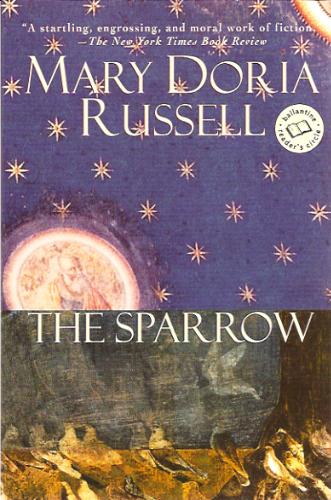
Books You Should Read: The Sparrow

 
I love this book. I love it so much I have bought it 10 times because I keep lending/giving it and needing to replace my own copy. Finally my friend Susie bought me a copy and wrote in it so I would not be tempted to give it away.
 
The basic premise is that songs are transmitted to earth from an alien planet and the first group to get the money and resources together to investigate are the Jesuits. They send a group of Jesuits and scientists with specific skills to find the source of the music. The trip takes half a lifetime there and back. The story is told in flashback by the only survivor of the mission to return to earth.
 
This is not a novel for the faint of heart. There are dark themes explored, but that is what makes it so great! You learn to love these characters and grieve for them.
 
I always give two pieces of advice when I lend this book. They are slightly spoilery, so stop reading if you like to be completely unbiased when you start a book.
  1. Do not, I repeat DO NOT read the “about the author” for this book until you have completed the book. The author is a scientist and her topic of specialization gives away a major plot point.
  2. If the story is too dark for you, push on through and then read the sequel Children of God – it will make you feel better.

Leave a comment

Filed under April 2011, Books You Should Read

New Story, New Motivation

I hit a wall, and I was avoiding writing. I hate to admit it, but I was not writing an hour a day (gasp, scream, oh the horror!). I’ve had another idea poking around in my brain for a couple of months. And like everything shiny and new it was much more appealing than my old crusty story.

I am officially and publicly cutting myself some slack. My goal right now is consistency and to develop good writing habits. Eventually I’m bound to get better, or at least lose my mind enough that I don’t care anymore. Like a good magpie I am choosing the shiny, new story – at least for now.

Poof! Like magic I’m back in the game. Switching focus was all it took to bring the spring back into my fingers on the keyboard. This leads me to wonder if ideas need vacations? By putting my original story on the back burner will my subconscious work on it like secret elves making shoes in the night? Was that what was happening to my shiny, new story these last couple months? I’m inclined to think it was because the new story is moving much faster, and I feel a clearer goal than before.

Or could I just be learning? If the secret to writing better is to, well, write, wouldn’t it make sense that things would get easier over time? Each story should be better, more fully formed, than the last. Then again, we’ve all read sequels that were inferior to the original. I’ve heard musicians say you have a lifetime to create your first album and a year to create the second. I assume that means once you’ve created something, and filled it with everything you have, what is left to fill the next creation? Maybe all we need is the luxury of time.

Or, maybe my first idea was junk and this one is more worthy of exploration. Only time will tell. Either way I’m setting my first hard deadling of the year: A complete draft (of either story) by Easter.

1 Comment

Filed under April 2011

Psychological Disorders as Writing Prompts?

I needed a better villain. So I did some brainstorming on my favorite villains …  Long John Silver, Voldemort, Darth Vader, Hanibal Lector, Dracula. Aside from the fact that most are male (no comment), most also happen to be CRAZY. I’m not a psychologist, but I do know that crazy is not a preferred diagnosis so I did some google searches into psychological disorders.

Entertainment has overused the multiple personality side of psychological disorders and there’s plenty of sociopaths in the mix as well. So I searched for unusual psychological disorders and found one that fit my villain and my story perfectly. That led me to wonder if this was just good backstory prep or am I cheating? By choosing the disorder and building the character around that am I going backwards? Shouldn’t I be establishing the charcter and then figuring out what kind of crazy they are?

Then I remembered something that I think I need to print out and tape to the wall by my computer: This is my story and I can do whatever I want. Why do I always feel like there are “rules” I need to follow when writing? If I want to work backwards that’s my business.

My villain’s disorder of choice is the Cotard Delusion, where the person believes themselves to be dead. I’m not sticking to any strict medical definition of that disorder, but that one sentence was enough to open up unlimited ideas for this particular character. At the moment I don’t plan to disclose the disorder in the course of the story, it just gives me consistent behavior for this person to follow that may seem illogical to a sane person.

I’ve now run into the problem of my villain being much more interesting (to me) than my protagonist. In the end I think that is a good problem to have because it will force me to spice up that character as well.

Leave a comment

Filed under April 2011